
Working in Norway in Construction: How Are Working Hours and Overtime Calculated?

Working in Norway in Construction: How Are Working Hours, Overtime and Salary During Rotation Calculated?
In the Norwegian construction sector, salary calculation may differ from what workers are used to in Lithuania. Before leaving for work, it is very important to understand what basic working hours are, when overtime starts, and why part of the salary may be paid during the rotation break.
Why is a 37.5-hour working week often mentioned in Norway?
Under Norwegian working time rules, the standard limits are up to 9 hours within 24 hours and up to 40 hours within 7 days. However, in practice, many companies and sectors, especially where collective agreements or sector-specific rules apply, often use a 37.5-hour working week.
This is especially relevant in the construction sector, because work schedules, overtime and rotation arrangements must be clearly agreed before the worker leaves for the project.
37.5 hours per week × 4 weeks = 150 hours per month. Therefore, in some job offers in Norway, the base salary may be calculated based on 150 hours.
Basic Hours
Often calculated according to a 37.5-hour working week, which equals 150 hours over 4 weeks.
Overtime
Hours above the agreed norm may be paid as overtime with an additional supplement.
Rotation
When working on rotation, salary payment may be divided according to work and rest periods.
When is overtime calculated in Norway?
Overtime in Norway must be paid with an additional supplement. The minimum overtime supplement under Norwegian rules is at least 40% of the agreed hourly rate. In some projects or under specific agreements, a higher supplement may apply, for example +50%.
Therefore, before accepting a job offer, it is important to clarify exactly from how many hours overtime starts in the specific project and what overtime rate applies.
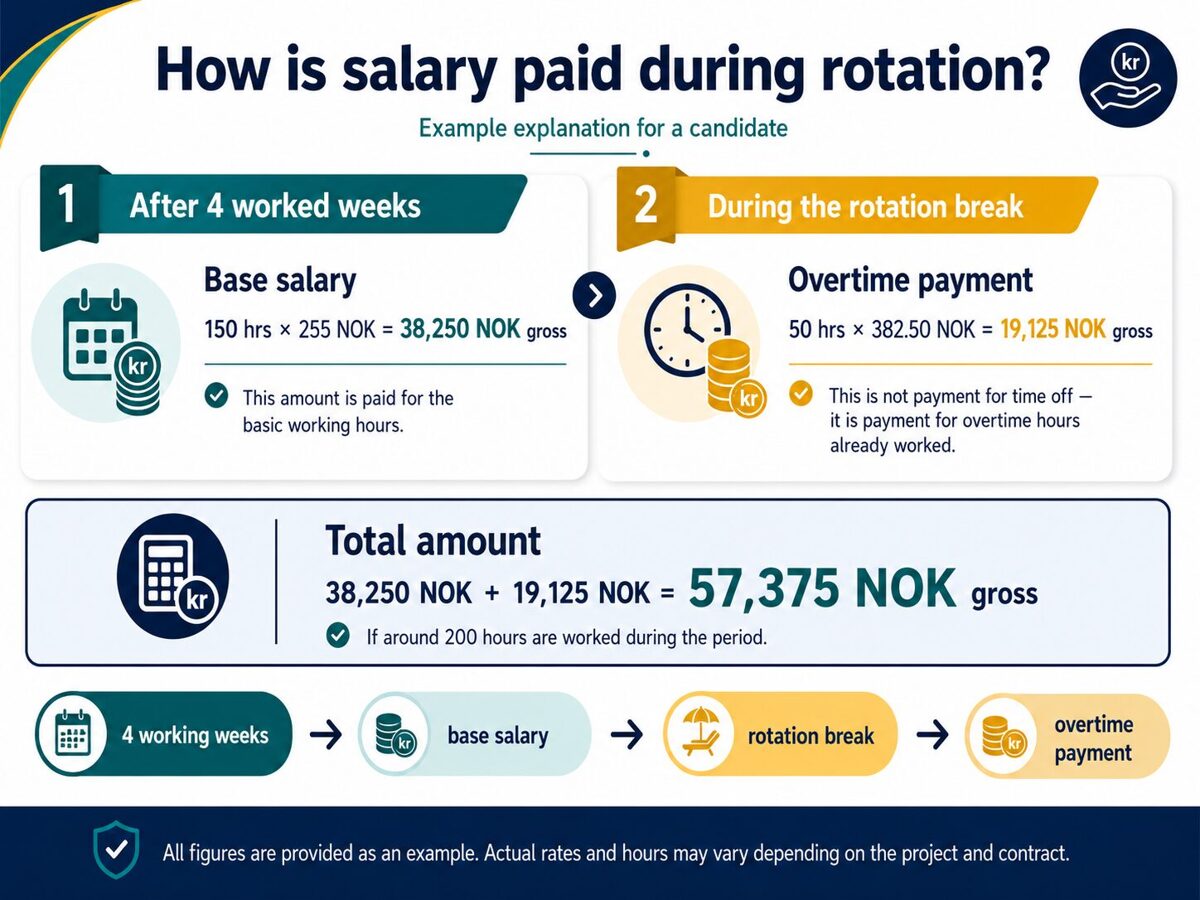
Example Salary Calculation in a Norwegian Construction Project
Below is an example calculation that helps explain how salary may be calculated when working in the construction sector in Norway. This is not a universal calculation that applies to all projects — the final amount always depends on the specific contract, project, schedule and actual hours worked.
Let’s assume that the worker’s base hourly rate is:
Basic monthly calculation:
If during the same period the worker actually works around 200 hours, the additional 50 hours may be calculated as overtime.
Total Example Amount
38,250 NOK + 19,125 NOK =
This amount is provided as an example when around 200 hours are worked during the period.
Why can part of the salary be paid during the rotation break?
When working on rotation, some companies may divide salary payments according to work and rest periods. For example, after 4 worked weeks, the worker may be paid the base salary part for 150 hours, while the overtime part may be paid when the worker begins the rotation break.
the amount paid during the rotation break is not an additional payment for time off. It may be payment for overtime hours that were actually worked earlier and are paid in a later payment period according to the employer’s payment system.
What should a candidate clarify before leaving?
Before accepting a job offer in Norway, we recommend that candidates clearly clarify the following points:
- What is the base hourly rate — gross or net?
- How many hours are included in the basic monthly calculation?
- From how many hours does overtime start?
- What overtime rate applies in the specific project?
- When is the base salary part paid?
- When is the overtime part paid?
- Is the rotation break a rest period, or are previously earned amounts paid during this time?
- What is the exact work schedule and rotation system?
Does a your country employment contract change the rules applicable in Norway?
If a worker is posted or sent to work in Norway, in many cases the basic working conditions applicable in Norway must be followed. This includes working time, overtime payment, a safe working environment, holiday rules and other mandatory requirements.
In other words, even if the employment contract is concluded in Lithuania, when the work is actually performed in Norway, Norwegian working time and overtime rules must be taken into account.
Conclusion
Work in the Norwegian construction sector can be financially attractive, but it is important to understand salary calculation before leaving. It is not enough for a candidate to know only the hourly rate — it is necessary to know how many hours make up the base, when overtime starts and how salary is paid during rotation.
If the base rate is 255 NOK/hour gross and a +50% supplement applies to overtime, an example calculation may look like this:
This is only an example calculation. The actual salary always depends on the project, work schedule, contract, actual hours worked and the employer’s payment system.
Looking for a Job in Norway?
Job Picker helps candidates understand working conditions before leaving: salary, work schedule, rotation, accommodation and the full recruitment process.
View Job Offers in NorwayUseful Official Sources
- Norwegian Labour Inspection Authority on working hours: Arbeidstilsynet – Working hours
- Norwegian Labour Inspection Authority on overtime: Arbeidstilsynet – Overtime
- Norwegian Labour Inspection Authority on posted workers: Arbeidstilsynet – Posted workers
- Norwegian Labour Inspection Authority on minimum rates of pay in certain sectors: Arbeidstilsynet – Minimum wage